

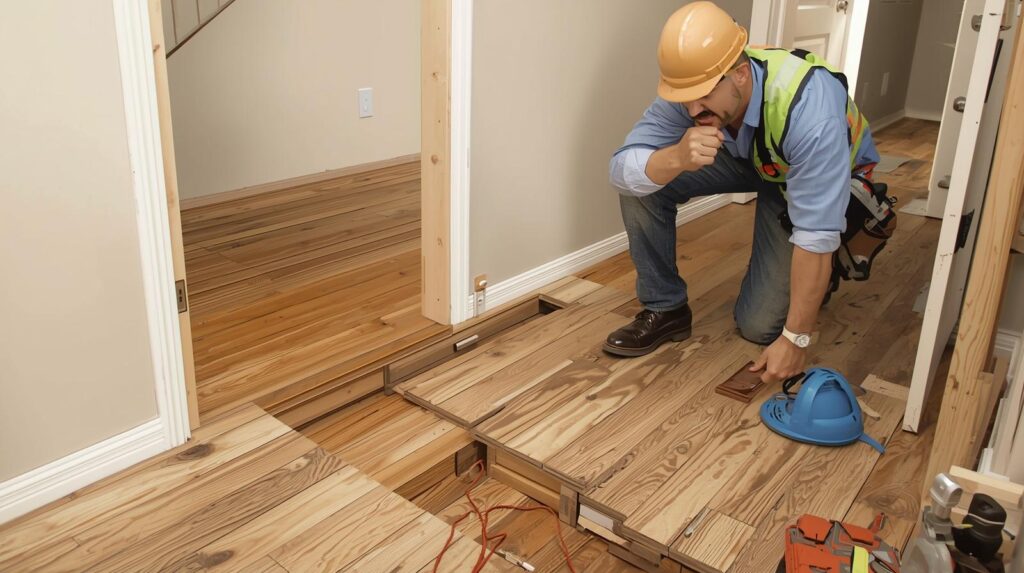
The renovation is complete. The walls are freshly painted, the new lighting fixtures are gleaming, and the dust has finally settled. The homeowner walks in for the final inspection, expecting perfection. But as they take their first steps across the brand-new laminate living room, they stop.
Crunch. Snap. Pop.
Or perhaps they look at the hallway and notice a strange phenomenon: the floorboards seem to be “peaking,” rising up like tiny tents at the joints. Or worse, there is a visible gap between the planks that wasn’t there last week.
The contractor sighs. He knows exactly what happened, and he knows it wasn’t a defect in the manufacturing. It was a failure to understand the physics of a “floating” floor during the construction process.
Laminate flooring has exploded in popularity because it is durable, affordable, and easy to install. However, it is also one of the most temperamental surfaces to manage on an active job site. The very feature that makes it easy to install—its floating nature—is exactly what makes it vulnerable to a specific type of construction damage.
The Physics of the Float
To understand the failure, you have to understand the mechanic. Unlike hardwood, which is often nailed to the subfloor, or tile, which is mortared in place, a laminate floor is a giant jigsaw puzzle that rests on top of the subfloor. It is held down by nothing but its own weight and friction.
Crucially, this puzzle needs to breathe. As the temperature and humidity in the house fluctuate—which happens wildly during construction when doors are open and HVAC systems are turned on and off—the laminate expands and contracts. A floating floor can expand by several millimeters across a large room.
This movement is healthy. The problem arises when we try to protect the floor.
The “Pinning” Problem
When painters and drywallers arrive to finish the room, their instinct is to protect the floor by covering it with heavy cardboard or plastic. To keep these covers in place, they use tape.
Here is the fatal error: They often tape the protective cover to the baseboards or the walls to ensure a “perfect seal” against dust.
By taping the floor covering to the wall, they have effectively anchored the floating floor. They have “pinned” the edges down. When the floor tries to expand due to the humidity of the drying paint, it hits the resistance of the tape. Since it can’t slide underneath the baseboard as designed, the pressure builds up until the planks buckle upwards, creating “peaking” at the seams.
Conversely, if the floor tries to contract and is pinned by heavy equipment or improper taping, the locking mechanisms (the click-lock joints) are pulled apart, creating permanent gaps that cannot be closed without reinstalling the floor.
The Gritty Reality of Joints
Beyond the movement issues, there is the issue of the joints themselves. Laminate relies on precision-milled “tongue and groove” systems. These tolerances are incredibly tight—fractions of a millimeter.
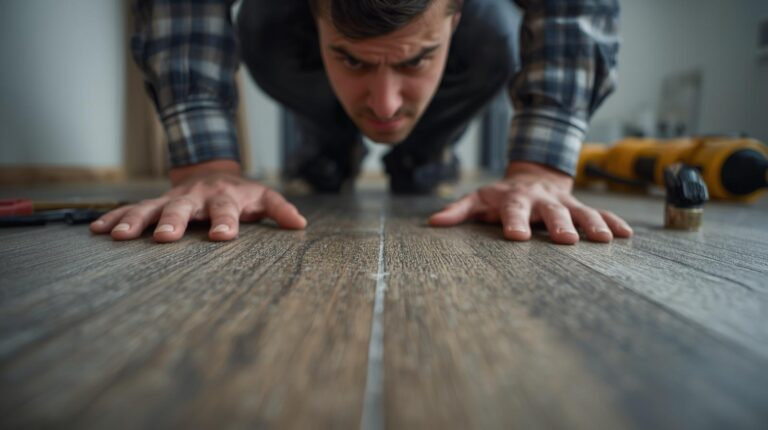
If the floor protection is loose, sliding, or porous (like standard cardboard), microscopic construction dust—specifically silica from drywall and masonry—filters down to the floor. Because the floor floats, every time a worker walks on the protection, the cover slides slightly, grinding that dust into the open seams of the laminate.
Once drywall dust gets into the locking mechanism, it acts like a wedge. It prevents the floor from sitting flat and creates friction. This is the source of the dreaded “crunch” sound. You cannot vacuum this dust out. It is buried inside the joint. The only way to fix a crunchy floor is often to rip it out and start over.
The Impact Myth
Finally, there is a misconception about durability. Laminate is marketed as “scratch-resistant,” which is true. The aluminum oxide wear layer is incredibly hard. But “hard” also means “brittle.”
If a carpenter drops a heavy wrench on a real wood floor, it leaves a dent. A dent adds character; it can be steamed out or filled. If that same wrench drops on a laminate floor, the melamine resin doesn’t dent—it shatters. It chips.
Standard rosin paper or thin plastic sheeting offers zero impact resistance. They stop paint, but they don’t stop physics. When heavy tools are in play, the floor requires a buffer that can absorb and disperse shock, not just deflect liquids.
Protecting the Float
The solution to these headaches is to treat the floor protection as a dynamic layer, just like the floor itself. The industry is moving toward specialized solutions that are designed to “float” with the system or adhere directly to the surface without pinning it to the perimeter walls.
Contractors are finding success with peel-and-stick mats that bond temporarily to the face of the planks. This ensures that when the floor expands, the protection moves right along with it. It eliminates the need for perimeter taping, preventing the “pinning” effect. Furthermore, because it creates a seal against the surface, it makes it physically impossible for that joint-destroying dust to migrate into the seams.
By utilizing proper laminate floor protection that respects the mechanical needs of the material, contractors can avoid the awkward conversations at the final walkthrough. The goal is to hand over a floor that looks—and sounds—solid, ensuring that the only thing floating is the feeling of relief that the project is finally done.
