

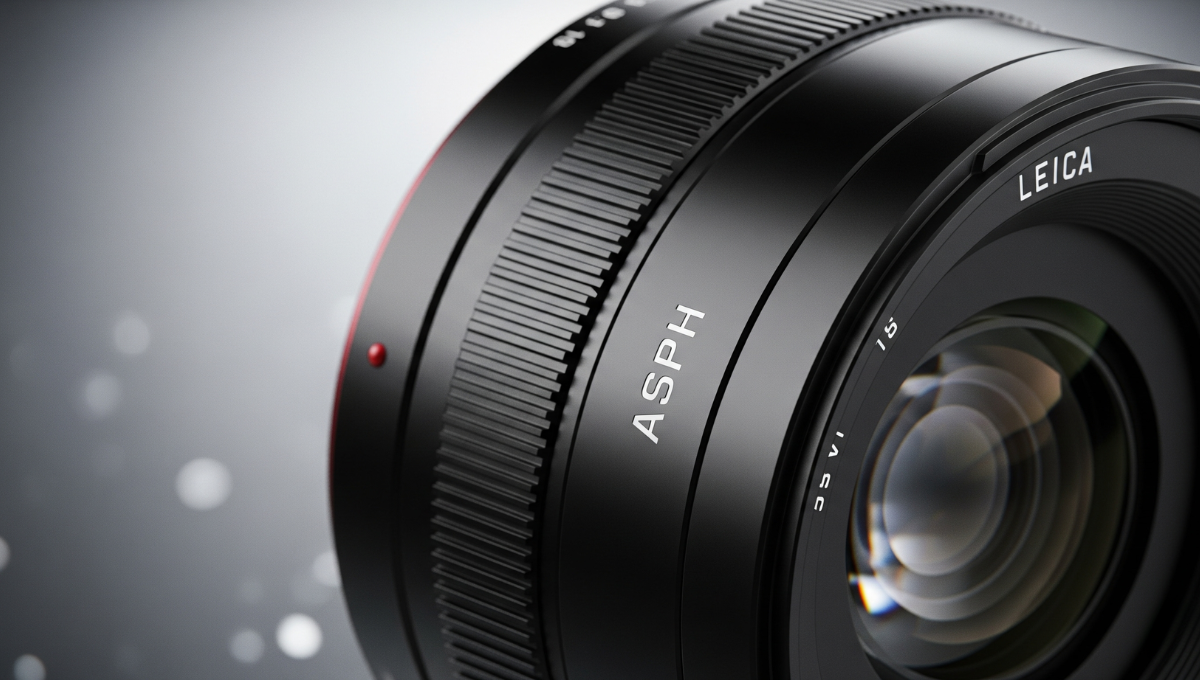
When exploring Leica’s premium line of lenses, you may come across a curious abbreviation: ASPH. Often found engraved on the barrel of high-end Leica optics, this small term represents a major leap in lens design and performance. But what does ASPH actually mean—and why does it matter for photographers?
Let’s break it down.
What Does ASPH Mean?
ASPH stands for Aspherical, referring to the use of aspherical lens elements within the optical design of a lens. These specially shaped elements are engineered to reduce optical aberrations and improve image quality, especially at wider apertures.
In Leica terminology, the “ASPH” label indicates that the lens contains at least one aspherical element—a significant feature that sets it apart from traditional spherical-only lenses.
Why Are Aspherical Elements Important?
Most basic lenses are made from spherical elements, which are curved like part of a perfect circle. While easier to manufacture, spherical lenses often introduce imperfections like:
-
Spherical aberration (soft edges)
-
Coma (distorted highlights, especially in night shots)
-
Field curvature (uneven focus across the frame)
Aspherical elements help correct these issues by using complex surface geometries that allow for more precise control over how light passes through the lens.
The result? Sharper images, better contrast, and more accurate rendering—particularly in fast lenses with wide apertures like f/1.4 or f/2.
Leica’s Use of ASPH Lenses
Leica was one of the earliest manufacturers to integrate aspherical technology into compact, premium lenses. Due to the company’s commitment to optical perfection and craftsmanship, the inclusion of an ASPH element often signals a top-tier piece of glass.
Some well-known Leica ASPH lenses include:
-
Summilux-M 35mm f/1.4 ASPH
-
Noctilux-M 50mm f/0.95 ASPH
-
Summicron-SL 50mm f/2 ASPH
Each of these lenses benefits from enhanced sharpness, minimal distortion, and exceptional performance in low light.
ASPH vs. Non-ASPH: What’s the Difference?
While non-ASPH Leica lenses still deliver outstanding quality, the difference becomes noticeable in demanding scenarios:
| Feature | ASPH Lens | Non-ASPH Lens |
|---|---|---|
| Edge-to-edge sharpness | Superior | May soften toward corners |
| Wide-aperture performance | Excellent control of aberrations | More prone to distortion or flare |
| Size & weight | Often more compact | Can be bulkier for same aperture |
| Cost | Typically higher | Slightly more affordable |
For professionals, collectors, or enthusiasts who prioritize flawless optical results, ASPH lenses are often worth the investment.
Are ASPH Lenses Worth It?
Yes—if image quality is a top priority. ASPH lenses offer improved performance, especially in challenging lighting and wide-open shooting. For Leica shooters who demand the best, this technology helps maintain the brand’s reputation for clinical sharpness, creamy bokeh, and unparalleled clarity.
However, if you’re a casual photographer or a fan of vintage character and rendering, a classic non-ASPH lens may still suit your needs—and often at a lower cost.
Final Thoughts
Understanding what ASPH means in Leica lenses isn’t just about decoding a three-letter abbreviation. It’s about appreciating the craftsmanship, engineering, and purpose behind Leica’s relentless pursuit of optical excellence. Whether you’re shooting street photography, portraits, or landscapes, an ASPH-designated lens ensures that your gear matches your creative vision with precision.
