

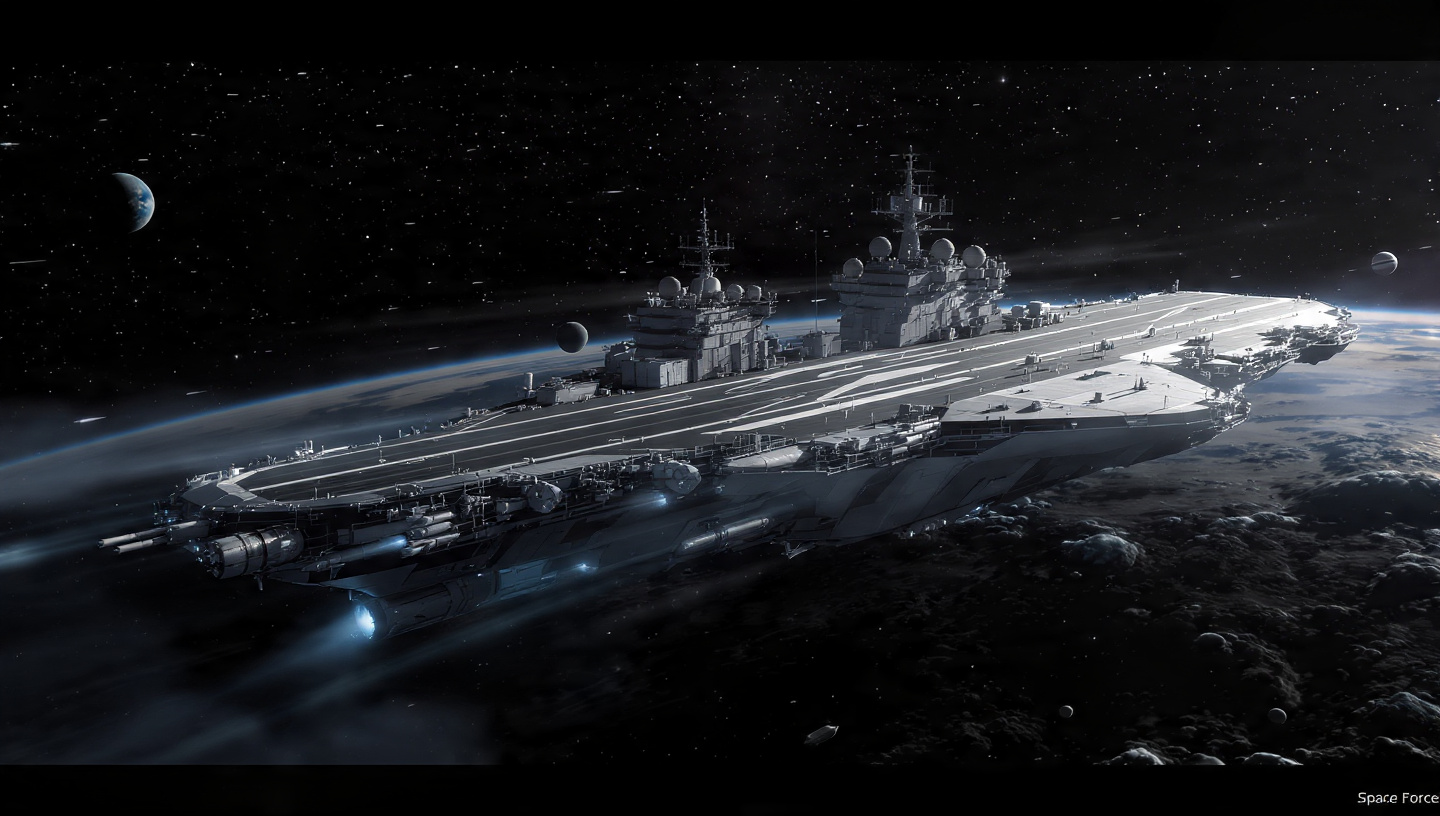
The idea of a Space Force orbital warship carrier refers to a large spacecraft designed to support smaller vehicles or assets in orbit, similar in concept to naval aircraft carriers but operating in outer space.
In recent years, the establishment of military space organizations — such as the United States Space Force — has led to increased interest in how strategic capabilities could evolve beyond Earth’s atmosphere, including conceptual platforms that support a wide range of space missions.
The term orbital warship carrier is largely speculative at this stage, rooted in science fiction and future planning scenarios rather than existing hardware.
However, it reflects serious thinking about how forces might be stationed, supported, and projected in space as humanity’s presence beyond Earth grows.
Historical Origins and Cultural Influence
The concept of space warships and carriers dates back decades in popular culture, especially in science fiction.
Books, movies, and television series such as Star Trek, Battlestar Galactica, and The Expanse have featured large mother ships that carry fighters, shuttles, or other craft into space battle.
These portrayals helped shape public imagination about what future military assets in space might look like.
While these fictional depictions are often dramatic, they also raise real questions about logistics, crew support, defense, and strategy in a space environment.
In the actual history of aerospace development, early strategic thinkers and engineers have occasionally sketched out analogous ideas.
During the Cold War, planners considered various concepts for orbital platforms that could host reconnaissance pods, communication relays, or defensive systems.
These ideas, while never realized in hardware, laid groundwork for thinking about large space platforms as more than just satellites.
Technical Foundations: What Would an Orbital Carrier Need?
A theoretical orbital warship carrier would require advanced propulsion systems capable of maneuvering in space while supporting the mass of attached vehicles.
Traditional chemical rockets are effective for launch and orbital insertion, but a carrier concept might rely on ion drives, nuclear thermal propulsion, or other high‑efficiency technologies to sustain long‑duration operations.
The power system for such a platform would also be critical.
Large solar arrays, nuclear reactors, or emerging power storage technologies would be necessary to support life support, communications, and operations for both crew and attached vehicles.
Thermal management is another challenge; space environments expose large structures to extreme temperature swings, requiring robust systems to regulate heat.
Additionally, docking and deployment mechanisms would be essential.
A carrier would need docking ports, robotic arms, or automated berthing systems to secure smaller craft and enable maintenance or resupply.
These technologies exist in early forms on the International Space Station (ISS) and commercial spacecraft, but scaling them up to handle an entire fleet concept remains an engineering frontier.
Operational Roles and Strategic Purposes
In speculative discussions, an orbital warship carrier could serve several roles, some of which already have analogs in existing space operations.
One such role is as a mobile logistics hub, supporting satellites, crewed missions, or scientific outposts by refueling, repairing, or repositioning assets.
Another potential role is as a command and control center, aggregating data from space sensors and serving as a relay for communications.
Importantly, any military use of space under international law must adhere to treaties and agreements, such as the Outer Space Treaty of 1967.
These agreements prohibit the placement of weapons of mass destruction in orbit and stress that space should be used for peaceful purposes.
As a result, discussions about space military assets — including carriers — are often framed in terms of support, deterrence, and defense rather than offensive warfighting platforms.
International Law, Diplomacy, and Space Governance
The legal and diplomatic context surrounding space activity directly influences how a concept like an orbital carrier would be perceived and regulated.
The Outer Space Treaty, signed by the United States, Russia, China, and many other nations, establishes that celestial bodies and orbits are free for exploration and use by all states and must be used for peaceful purposes.
This does not prevent national space forces from existing, but it does constrain how they can operate, especially regarding weapon deployment or offensive capabilities.
Scholars and policymakers are actively debating how to update or expand space law to address modern realities, including commercial space travel, asteroid mining, and orbital infrastructure.
Future treaties may specifically address large space platforms, permissible activities, and transparency requirements to reduce the risk of misunderstanding or escalation among spacefaring nations.
Looking to the Future: Realistic Trajectories and Challenges
While current technology does not support the construction of fully operational orbital warship carriers — and policy frameworks limit their armament — the concept remains useful for exploring future space capabilities.
Advances in modular spacecraft design, in‑orbit assembly, and autonomous robotics could eventually make large orbital platforms feasible for peaceful and supportive purposes.
For example, commercial companies like SpaceX and Blue Origin are already working on reusable spacecraft, orbital refueling depots, and other infrastructure elements that could become components of larger platforms.
The challenge for governments, industry, and international bodies will be to balance innovation with safety, law, and shared human interests in space.
By engaging thoughtfully with concepts like the orbital warship carrier, stakeholders can better prepare for a future where humanity’s operations in orbit are more complex, coordinated, and impactful than ever before.
