

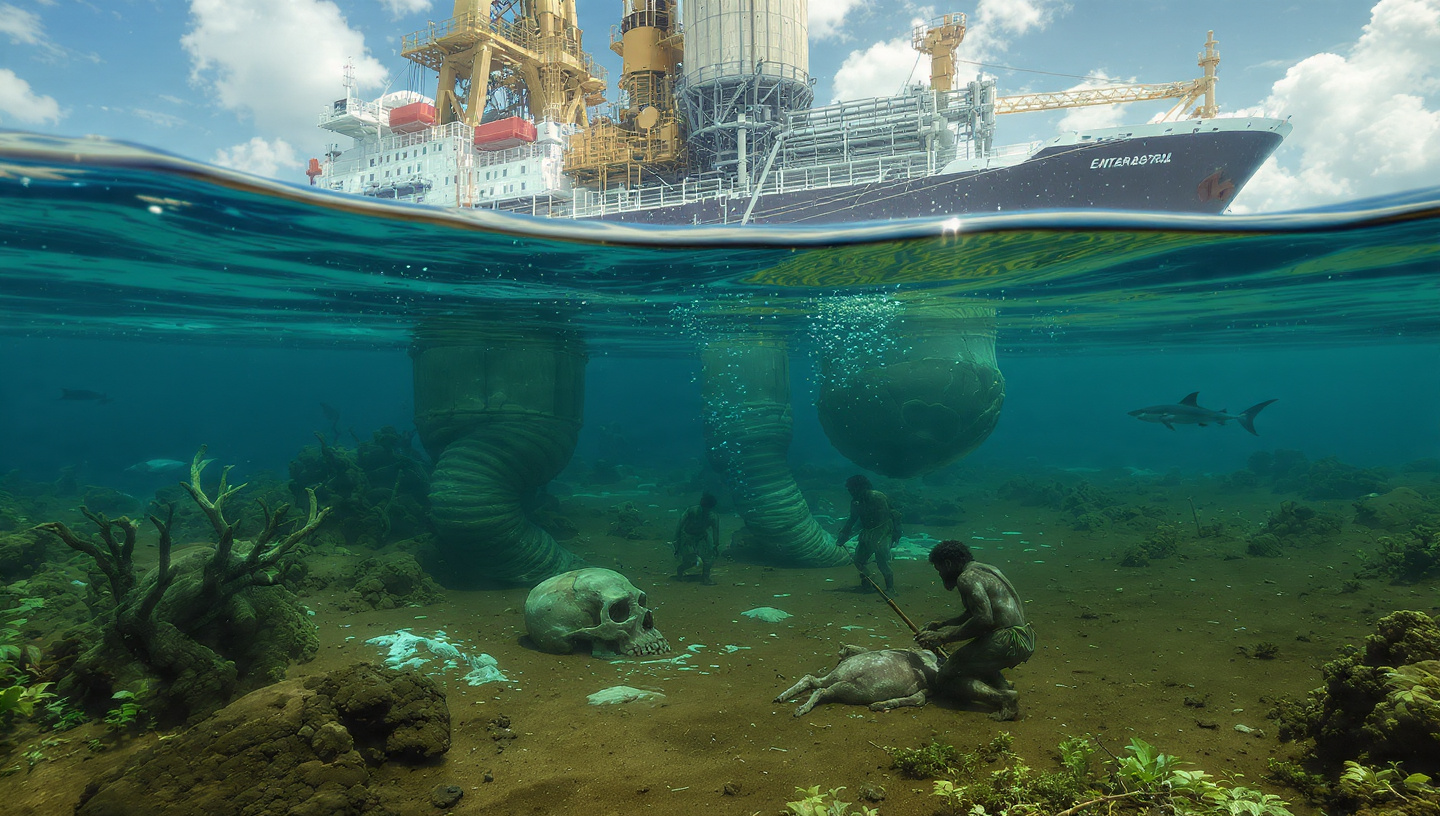
In a groundbreaking development for human evolutionary research, scientists have uncovered the first hominin fossils from the now‑submerged landmass known as Sundaland — a vast region of Southeast Asia that was exposed during periods of lower sea levels in the Pleistocene.
These fossils, discovered on the floor of the Madura Strait between Java and Madura in Indonesia, represent direct evidence that early hominins, including Homo erectus, once inhabited landscapes that are today underwater.
The find not only reshapes our understanding of early human migration patterns in Asia but also highlights the importance of submerged archaeology in reconstructing our deep past.
What Is Sundaland?
Sundaland refers to a now‑drowned expanse of land that once connected large parts of Southeast Asia, including present‑day Sumatra, Java, Borneo, and the Malay Peninsula.
During glacial periods of the Pleistocene, sea levels were much lower than today, exposing the Sunda Shelf as a broad, fertile plain where plants and animals — including ancient humans — could thrive.
This lowland landscape likely offered abundant resources: rivers, forests, and open plains that could support diverse life, from large mammals to early hominins.
As global temperatures warmed and ice sheets melted, rising seas submerged much of Sundaland, obscuring these ancient habitats beneath the Java Sea and surrounding waters.
Discovery of the Hominin Fossils
The fossils were recovered unexpectedly in connection with a marine sand dredging operation in the Madura Strait, conducted to build an artificial cargo island for port development near Surabaya, Indonesia.
During the extraction of more than five million cubic meters of sand, scientists and geologists noted large quantities of vertebrate fossils.
Among these were two hominin specimens dubbed Madura Strait 1 (MS1) and Madura Strait 2 (MS2) — the first ever identified from submerged Sundaland.
The discovery was remarkable because until now, hominin fossils in Southeast Asia were mainly recovered from terrestrial sites such as Java and Flores, not from underwater landscapes.
Who Were the Ancient Inhabitants?
Analysis of the fossil material suggests that MS1 is morphologically very similar to late Middle Pleistocene Homo erectus fossils previously found on Java, dating roughly between 140,000 and 92,000 years ago.
This places the Sundaland hominin firmly within the broader context of Homo erectus populations known from Asian sites.
MS2, however, could not be definitively assigned to a specific species, though it appears most similar to other archaic Homo groups.
Together, the specimens indicate that early humans once ranged across the exposed lowland plains of Sundaland, not just isolated islands like Java.
Geological Context and Dating
The fossils were embedded in deposits from a submerged river valley of the Solo River system, which once flowed across the Sundaland plain.
Scientists used optically stimulated luminescence (OSL) dating to determine that the sediments containing the hominin remains fall within Marine Isotope Stage 6 (MIS6), a colder period between roughly 162,000 and 119,000 years ago.
During MIS6, sea levels were significantly lower than today, allowing Sundaland to be exposed as dry land where humans and other animals could have lived and migrated.
As global climates warmed and sea levels rose again, these valleys were drowned — preserving fossil‑bearing sediments on the seabed.
Why This Discovery Matters
This find has major implications for understanding human evolution and dispersal in Asia.
Until now, most evidence of early human occupation in Southeast Asia came from islands like Java, where famous Homo erectus fossils were excavated over the past century.
The Sundaland hominin fossils reveal that these ancient humans were not restricted to isolated islands but also inhabited vast lowland regions that were later submerged.
This expands the geographical range of Homo erectus and suggests dynamic movement across now‑lost landscapes.
It also highlights how sea‑level changes played a key role in early human migration and settlement patterns — with populations adapting to shifting environments across millennia.
A Rich Ecosystem Beneath the Waves
The Madura Strait site has yielded thousands of vertebrate fossils alongside the hominin remains, including animals such as turtles, deer‑like bovids, giant tortoises, hippos, and even river sharks.
Some of these animal bones exhibit cut marks, indicating that early humans may have hunted, butchered, and processed animals for food, offering a glimpse into their daily lives and subsistence strategies.
This helps paint a picture of a thriving Pleistocene ecosystem, where hominins and a wide range of fauna coexisted on the fertile plains of Sundaland.
Challenges and Future Potential
Recovering fossils from submerged landscapes is technically difficult and expensive, often only possible when dredging or construction brings buried material to the surface.
As a result, much of Sundaland’s ancient record remains hidden beneath the sea, and scientists must rely on chance discoveries or targeted underwater archaeology.
However, researchers believe many more fossils — of hominins and other species — could still lie beneath the waves, waiting to be found by future projects.
Continued collaboration between paleontologists, geologists, and marine engineers will be essential to uncovering more of this lost chapter of human history.
Conclusion
The discovery of hominin fossils in submerged Sundaland marks a new chapter in our understanding of early human history in Southeast Asia.
By revealing that Homo erectus and perhaps other archaic humans once lived across this vast Pleistocene landscape, the find underscores how ancient environments shaped migration, adaptation, and survival.
As underwater archaeology advances, researchers hope to uncover even more clues from the sunken plains of Sundaland — shedding light on the remarkable story of our ancestors.
