

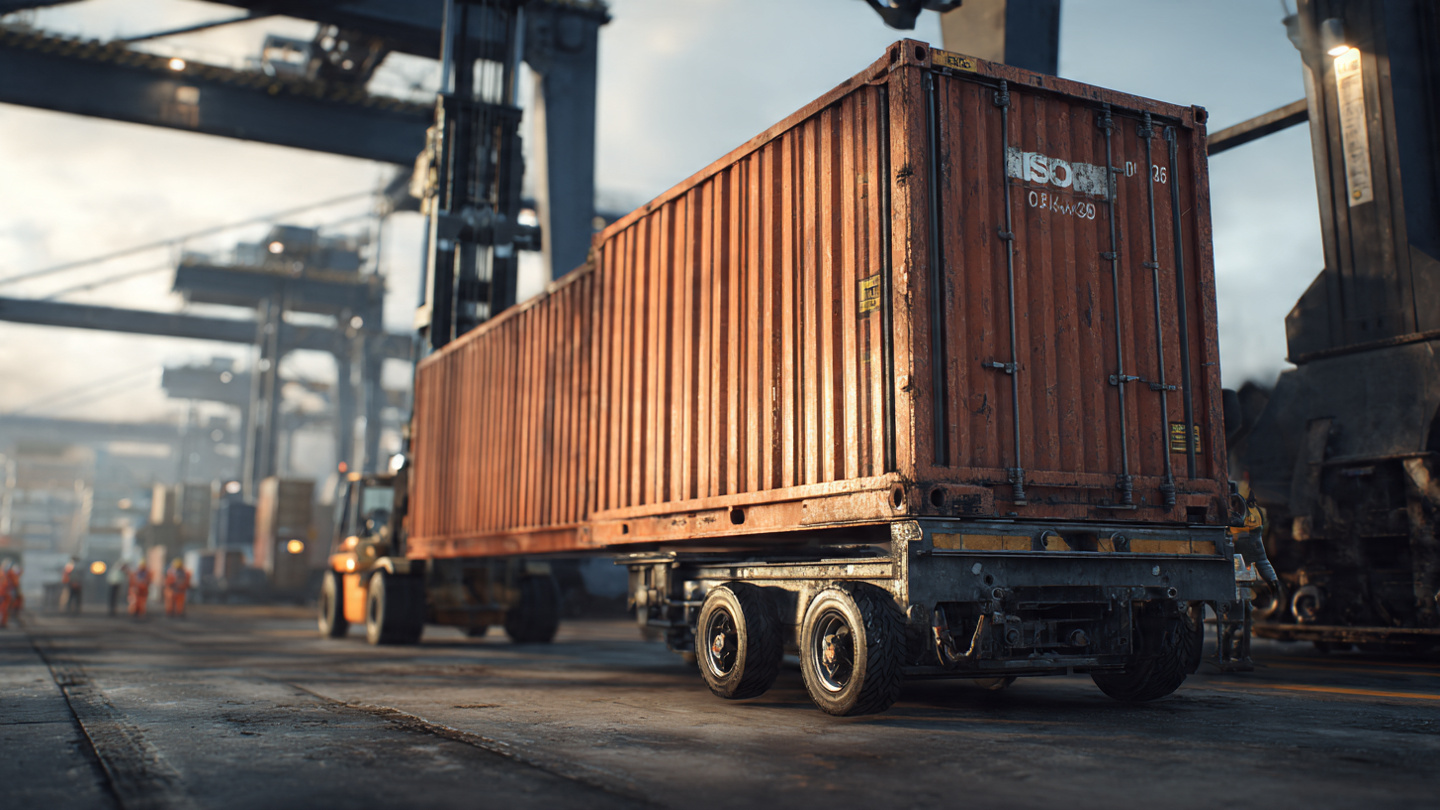
The standardized ISO shipping container is arguably the most important invention of the modern global economy. It is a masterpiece of simple, rugged engineering designed to be stacked nine-high in the belly of a cargo ship, strapped to the bed of a railcar, and hoisted through the air by massive gantry cranes.
However, a fundamental problem arises the moment a container arrives at a location that lacks a multi-million-dollar overhead crane. How do you move a 30-ton steel box across a warehouse lot, a military forward operating base, or a rural construction site?
The seemingly obvious answer is to drag it or pull it. But treating an ISO container like a simple wagon introduces a massive web of physical and logistical challenges. Turning a static, heavy-duty storage unit into a mobile, towable asset requires manipulating the laws of physics and relying on highly specialized hardware.
The Vertical Bias of the Corner Casting
To understand the difficulty of moving a container horizontally on the ground, we have to look at how it was engineered to be handled.
Every standard shipping container features eight corner castings—heavy, reinforced steel blocks with oval holes located at the eight corners of the box. These castings are the absolute strongest points on the container. The entire structural integrity of the box relies on them.
However, these castings were engineered with a severe vertical bias. They are designed to handle the immense compressive weight of other containers stacked on top of them, and the vertical tension of a crane lifting them straight up into the air.
When you attach a chain to the bottom corner castings and attempt to drag or pull the container horizontally, you introduce severe lateral shear stress. The container frame is incredibly rigid, but aggressive, uneven horizontal yanking can eventually warp the doors, misalign the locking rods, and damage the structural welds.
The Caster Wheel Solution
To eliminate the friction of dragging the container, engineers developed heavy-duty container caster wheels. These specialized, industrial-grade wheels feature mounting plates that lock directly into the bottom corner castings using a twist-lock mechanism—the exact same mechanism a crane uses to lift the box.
By inserting fixed caster wheels into the rear castings and swivel wheels into the front castings, the container is instantly transformed into a massive, four-wheeled cart. It is now completely mobile, but that mobility introduces a new, terrifying problem: momentum.
The Physics of the Pull
If you put a fully loaded, 60,000-pound container on wheels, you cannot simply chain it to a tractor and hit the gas.
A flexible connection, like a heavy steel chain or a nylon tow strap, is extremely dangerous when dealing with massive weight on wheels. If the towing vehicle—whether it is a heavy-duty forklift, a yard tug, or a tractor—suddenly applies its brakes, the 60,000-pound container will not stop. The chain will go slack, and the immense forward momentum of the container will cause it to crash violently into the back of the towing vehicle.
This is where specialized shipping container towing equipment becomes mandatory. Safe movement requires a rigid connection that transfers both pulling and braking forces.
The Architecture of the Tow Bar
The solution is the industrial container tow bar (often called a drawbar).
Unlike a standard trailer hitch, a container tow bar utilizes a heavy-duty “V” or A-frame design. The two wide ends of the “V” lock securely into the two front bottom corner castings of the container. The narrow point of the “V” connects to the towing vehicle’s hitch pin.
This specific geometry serves three vital purposes:
- Load Distribution: It splits the pulling force equally between the two front corner castings, preventing the frame from twisting or warping under heavy loads.
- Braking Transfer: Because the bar is made of rigid, heavy-duty cast iron or steel tubing, it acts as a physical barrier. When the forklift brakes, the rigid bar instantly halts the container, preventing a collision.
- Tracking and Steering: The A-frame design forces the front swivel casters to track perfectly behind the towing vehicle, preventing the massive box from swaying or jackknifing during tight turns in a crowded yard.
The Limits of the Wagon
While caster wheels and rigid tow bars effectively turn an ISO container into a steerable wagon, it is crucial to understand the limitations of this modular mobility.
These setups are strictly for low-speed, off-road applications—typically limited to maximum speeds of 3 to 5 miles per hour (around 5 to 8 km/h). They are designed to navigate flat, hard-packed surfaces like concrete warehouse floors, asphalt shipping yards, or dry, hard dirt. They lack suspension, independent braking systems, and highway-rated tires, meaning they can never be used on public roads or steep inclines.
Conclusion
The ability to move a massive shipping container without a crane is a triumph of modular engineering. By utilizing the existing strength of the corner castings, adding industrial caster wheels, and employing the precise geometry of a rigid tow bar, ground crews can safely manipulate thousands of pounds of steel. It proves that with the right application of physics and specialized hardware, even the most immovable objects can be steered with precision.
