

Power strips stand out as highly versatile and essential electrical accessories. These attachments are designed to power multiple electrical devices simultaneously, improving convenience at home and in the office.
While shorter than extension cords, power strips make up for that apparent limitation by their higher number of outlets.
Power strips are also considerably longer than power cords. As such, they can help in connecting bulky appliances without necessarily inching them closer to the wall sockets.
However, power strips aren’t equal. Extreme caution is critical when shopping for these devices.
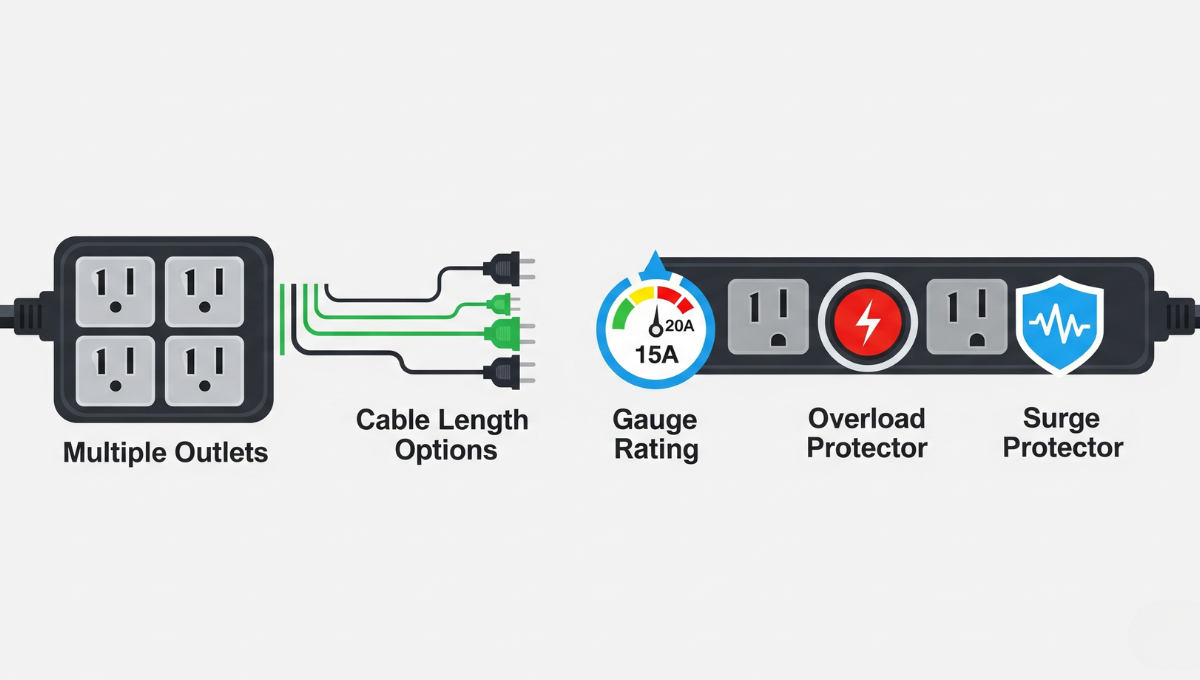
Below are the five essential features to look for in a power strip for residential use.
1. Number and Type of Outlets
While shopping for a quality power strip, it’s best to consider the number of devices you’re looking to connect simultaneously. Choose a strip with 2 or 3 outlets more than the appliances you intend to plug into it.
This addresses the potential need for extra sockets in the future. Besides, it ensures there are always spare outlets in case some faults develop.
In addition to the number of outlets, it’s prudent to consider the socket design.
Most power strips come with two-pronged or three-pronged receptacles. The core difference is that the extra outlet in three-pronged receptacles connects to a grounding wire, which safely channels electric current to the ground during electrical faults or short circuits.
Ultimately, the choice between two-pronged and grounded receptacles will depend on your existing appliances’ plug types. Note that two-pronged plugs are incompatible with both two-pronged and three-pronged receptacles, while three-pronged plugs only work with grounded receptacles.
2. Cable Length
If the primary goal is to extend the reach of electricity rather than connect several appliances concurrently, you’ll probably go looking for an extension cord. However, that shouldn’t discount the significance of cable length when shopping for power strips.
Extended power strips enable electrical current to reach greater distances from the wall outlet. With extra footage, you can power bulky or delicate appliances without moving them closer to the wall outlet. Longer power strips also minimize the need for daisy chaining.
Daisy chaining involves connecting multiple power strips in a series or sequence, usually extending the reach of a shorter cable or add extra outlets. The practice can overload a circuit and increase the risk of fires.
However, longer power strips are a tripping hazard. That’s particularly true for poorly organized cables.
Frequent tripping can result in devastating accidents at home, leading to unintended medical expenses.
Extended power strips are more susceptible to experiencing voltage drops. Each additional foot of footage increases resistance, causing a significant reduction in the cable’s voltage.
Most power strips come in lengths of 6 feet, 10 feet, and 15 feet. 25-foot options are also available, especially for outdoor usage.
To balance length and efficiency, buy a power strip that’s about one foot longer than the furthest appliance that needs connecting.
3. Gauge Rating
Gauge is a measurement that indicates the thickness or diameter of electrical conductors. The measurement excludes insulation and jacket.
All electrical cables, including power strips, come with specific gauge ratings. The ratings are assigned numerical values that are inversely proportional to a wire’s actual conductor thickness.
For instance, a 12-gauge power strip contains diameters measuring approximately 0.109 inches (2.77 millimeters) thick. That’s higher than 14-gauge strips, whose diameters measure roughly 0.0747 (1.9 millimeters).
Smaller values correspond with thicker conductor diameters, and vice versa. In North America, the initials AWG (American Wire Gauge) appear after the numbers.
Most household appliances require 12 AWG and 14 AWG power strips. 14-gauge wires can power most lighting fixtures and 15-amp circuits, while 12-gauge cables can safely power 20-amp circuits.
If you need to connect to heavier-duty appliances like water dispensers, consider a 10-gauge wire or less.
However, keep in mind that power-hungry equipment should not be used with power strips or extension cords. While you can safely plug your home’s entertainment system into a power strip, kitchen appliances like refrigerators are best connected to wall sockets through their built-in power cord.
4. Safety Features
Electrical hazards present in various forms, from minor shocks to electrocution. As these risks are often unpredictable, the surest way to minimize them is by investing in power strips equipped with advanced safety features.
Some key specifications to consider include;
Overload Protectors
An overload protector automatically shuts off the power supply during circuit overloads by blowing out an in-built fuse or tripping a circuit breaker.
It prevents excessive current flow, which could result in appliance overheating and fire hazards.
Surge Protectors
Surge protectors guard against dramatic increases in voltage levels.
Voltage refers to the speed at which current flows through a circuit in a unit of time. It differs from amperes, which measures the amount of electricity flowing through a circuit.
While electrical circuits experience continuous voltage fluctuations, major events like lightning and power rationing can cause drastic voltage surges. Without proper protection, the spikes may cause damage to connected appliances.
GFCI
A ground-fault circuit interrupter (GFCI) is a safety device that guards against electrical hazards caused by ground faults.
Ground faults occur when electrical current deviates from its intended path, often flowing through a person or directly to the ground, which can be dangerous. They typically result from an imbalance in the amount of current conveyed through the Hot and Neutral wires and are common while using power strips in moist settings.
5. Indoor versus Outdoor Power Strips
Although power strips are commonly found indoors, they may be just as effective for outdoor projects like lawn mowing or patio lighting. You only require the right attachment based on the intended application.
When shopping for outdoor power strips, look out for the following designations on the cable’s jacket;
W
W symbolizes weather-resistant. It specifically denotes power strips designed with waterproof insulation and jackets.
E
E represents elastomer, specifically referring to thermoplastic elastomer (TPE).
TPE is remarkably durable and flexible. The material is resistant to various environmental aspects, including mechanical stress, dramatic temperature fluctuations, and ultraviolet (UV) rays.
Those properties make it a popular material for power strip insulation and jackets.
O
A single “O” on power strips denotes that only the outer jacket is resistant to oil, while “OO” indicates that both the jacket and the insulation are oil-resistant.
Final Word
The right power strip doesn’t just support simultaneous device connections. It also minimizes electrical hazards, which could lead to costly appliance breakdowns. However, investing in a premium power strip isn’t enough. Proper and safe usage is just as crucial to ensure the device operates at optimal efficiency.
Some essential power strip maintenance tips include avoiding overloading, using the strips in a dry environment, and carefully organizing longer cables to prevent damage. Besides, inspect your power strips regularly for signs of damage. Dents, frays, and exposed conductors are your cue to get the device repaired or replaced.
